Showing posts with label Jewish Holidays in pre-1900 US Newspapers. Show all posts

Sunday, September 21, 2014

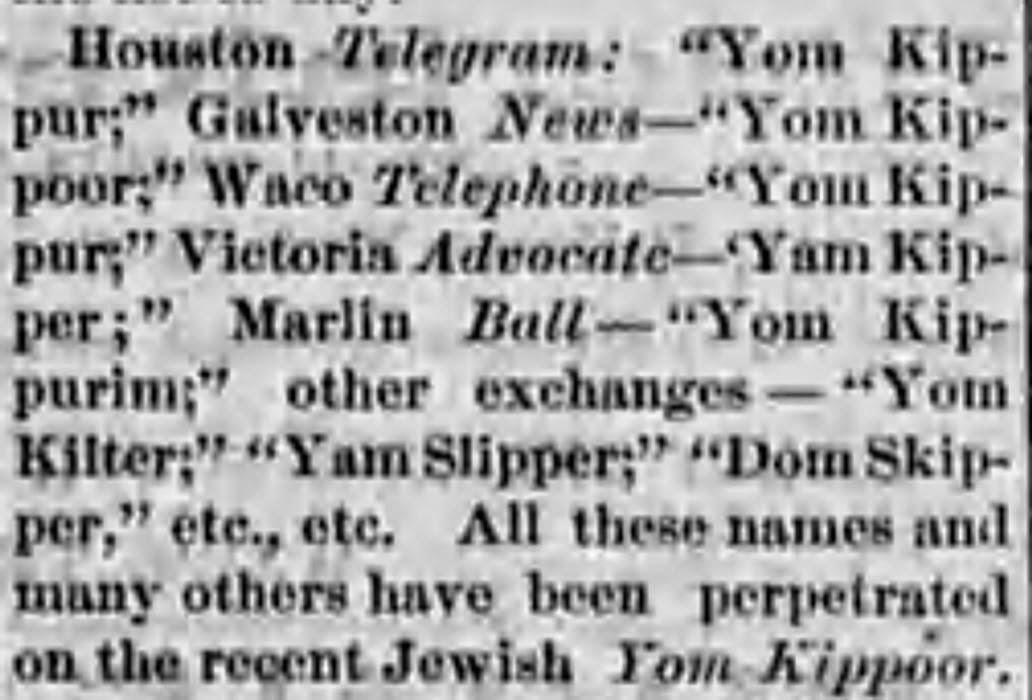
The Waco Daily Examiner, Friday, October 11, 1878

Reported in the "Here and There" column:

Houston Telegram: "Yom Kuppur;" Galveston News--"Yom Kipoor;" Waco Telephone--"Yom Kippur;" Victoria Advocate--"Yam Kipper;" Marlin Ball--"Yom Kippurim;" other excanges--Yom Kilter;" "Yam Slipper;" "Dom Skipper," etc., etc. All these name and many others have been perpetrated on the recent Jewish Yim Kippoor.

The Daily Inter-Ocean (Chicago, Illinois), September 28, 1876

YOM KIPPUR

Last evening began the holiest of Hebrew holidays, namely the Great Day of Atonement, or, as it is known in the calendar, Yom Kippur. The fast continues until this evening, and will be very generally observed in all the synagogues by the Jews, and the time spent in services of a devotional character by all the branches of the Hebrew Church. In this city the day will be observed by every member of the Jewish communion above 13 years of age, and to give entire attention to this all places of business will be closed.

The Atlanta Constitution, Wednesday, September 15, 1869

YOM KIPPUR.--Yom Kippur, or Day of Atonement, is the title of the holy-day observed by our Jewish fellow citizens to-day. It is a day of fasting and prayer, and they observe it religiously and sincerely.

Reading Times (Reading, Pennsylvania), Thursday, October 13, 1864

JEWISH FAST DAY--The Jews observed Monday as a fast day. It is know as Yom Kippur, Day of Atonement. Every Israelite in every part of the world who believes in the law of Moses and the doctrine of a future world, keeps the day as a strict fast-day. From sunset on Sunday till sunset on Monday, no food or drink were indulged in. Every Jew and Jewess, and children above thirteen, must observe the fast. Even those who make light of other observances throughout the year, pay due regard to this day.

The Weekly Kansas Chief (Troy, Kansas), Thursday, October 4, 1883

Monday was Rosh Hashana. We trust out readers observed it with due reverence.

The Washington Times (Washington, District of Columbia), Saturday, September 2, 1899

HEBREWS' HAPPY SEASON

The Jewish New Year Will Begin at Sunset Monday

Impressive Services Will be Held by the Washington Hebrew, the Adas Israel, and the Avas Shoben Congregations--A Local Rabbi Gives a Summary of the Celebration

Rosh Hashana, the Jewish New Year, will be celebrated in Washington beginning Monday evening at sunset and continuing until Tuesday and Wednesday at sunset. There will be special services in the Jewish churches. Rabbi Louis Stern, of the Washington Hebrew Congregation, popularly known as the Eighth Street Temple, will hold services at 7:30 p.m. Monday and 10 a.m. Tuesday, the latter service lasting for two hours with a sermon by the rabbi. There will be special music by the chois, the quartetteof which consists of Mrs. Nellie Wilson Shir-Cliffe, soprano; Mrs. Marguerite Nolan Martin, alto; John H Nolan, bass; William D. McFarland, tenor. The organist if George W. Walter.
........
This is the 5660th year in the Jewish calendar, being the first day of the seventh month of Tishri, which is the day of the civil year, and dates from the time of Ezra, when the Children of Israel returned from Babylon to Jerusalem.
........
Rosh Hashana is followed by ten days of penance, ending in the Day of Atonement called Yom Kippur, when the faithful Jewish people fast from sunset to sunset. This year Yom Kuppur will begin at sunset Thursday, September 14.

The Salt Lake Tribune, Monday, October 1, 1894

The observance of Rosh Hashana, or Jewish New Year 5695, began at sundown last evening and will continue through the customary period, the observance embracing a chapter of sacred events, to finally culminate in the grand Purim festival, that has become a part of the social customs of all civilized lands.

The observance is participated in by the orthodox and reformed Hebrews, whose rituals are identical save in that which fixed the actual date of the new year upon the Jewish calendar, and to cover this doubt the orthodox branch continues the ceremonies over two days.

The reformed branch began its ceremonies at the Synagogue last evening at 8 o'clock, at which hour the temple was filled with a large congregation, who listened to the exhortations by Mr. A Stiefel and Mr. Sig Simon, while the choir under the direction of Professor Krouse and composed of Mrs. Dr. Plummer, soprano, Miss Lucas, contralto, Mr. Jos Obendorfer, baritone, and Mr. Carlisle, tenor, rendered most impressive music.

The fast had then begun and will continue until the blowing of the shofar, or ram's horn, at 11 o'clock this morning by Mr. Stiefel, who has for years administered that portion of the Jewish ceremony.

The service by the orthodox branch took place at Odd Fellows' Hall during the evening, and was conducted by Messrs. M. C. Phillips and Carl Young. The service consisted of reading from Sephor Thora, or the scroll containing the five books of Moses, of prayers and other solemnities in which a large number took part.

On Wednesday comes the Day of Atonement, which will also be observed by both branches with impressive ceremony, and so on through the period of observance.
Logansport Reporter (Logansport, Indiana), Wednesday, September 21, 1892

Rev. Aaron Friedman arrived from Cincinnati yesterday, and is the guest of Mr. and Mrs. Sol. Wise. He will conduct the services of Rosh Hashana or the Jewish New Years at the Universalist church this evening.

Tombstone Weekly Epitaph (Tombstone, Arizona), Saturday, September 17, 1887

The Hebrew feast of Rosh Hashana will commence to-morrow (Sunday) at 6 p.m., and will last twenty-four hours. It will be duly observed by our Jewish fellow-citizens, who will close their places of business.

The Brooklyn Daily Eagle, Tuesday, October 2, 1883

ROSH HASHANA
 
The First Day of the Jewish new Year 5644--How It was Introduced and What it Means--Services in the Synagogues
 
Rosh Hashana, or the Jewish new Year, commenced last evening at sunset, and appropriate services were held in all the synagogues in the city. The new year is know as 5644. Mr. Raphael Lewis, one of the best known Israelites in this city and a gentleman well versed in Judaism, explained to an Eagle reporter that Rash Hashana or Day of Memorial was celebrated on the first day of the seventh month. In the Biblical time New Year's Day was not kept as such, but was regarded as a festival which was to proclaim the advent of the seventh month, in which the holiest of days (Day of Atonement) and the most joyful feasts (Feast of Tabernacles) were to be observed, and for this purpose the cornet is ordered to be sounded on that day. At a later period, however, when it was felt necessary to celebrate the feast at the beginning of the year without introducing a new festival for this purpose, it was found the more appropriate to connect the celebration of this desired New Year's Day with the Day of the Cornet. Last night the festival was celebrated in Temple Israel, on Greene avenue; at the Synagogue Elohim, on Boerum place; at Beth Elohim, on Pearl street, and by the Hebrews who worship in the Brooklyn Institute.


The Louisiana Democrat (Alexandria, Louisiana), Wednesday, September 12, 1877

Our Hebrew fellow-citizens celebrated in due form, Saturday, the 8th of September, being their New Year, or Rosh Hashana. On the 17th inst., the 10th of Tishri, is Yam Kepoor [Yom Kippur], the day of Atonement.

Southern Illustrated Age (Raleigh, North Carolina), Monday, August 30, 1875

THE FEAST OF ROSH HASHANA

Last evening (September the 29,) at sunset our fellow citizens of the Hebrew faith repaired to their respective places of worship to celebrate the feast of Rosh Hashaha, (i.e.,) the Civil New Year 5636 of the creation of the world, which will last one day, being the first day of the seventh month of Tishri, corresponding this year with the 30th of September.

This day, as well as the day of atonement, to which this is a preparatory is strictly observed by all Israelites even by those who during the whole year consider the performance of their Jewish precepts and custom a secondary duty. This new year feast is inaugurated quite different from the year whose advent is greeted generally as a period of revelry and worldly enjoyments. The sound of the Shafir (Rams Horn) is heard during the morning service, which service takes up a large portion of the day, and heartfelt prayers are sent up to the God of Israel for peace, happiness and prosperity for all mankind.

Our worthy Jewish citizens in this city have very neatly fitted up a ???? the business place of Messrs M. Rosenbaum & Bro., on Fayetteville street for a place of worship, and the service will commence to-day at 9 o'clock a.m.

Whig and Tribune (Jackson, Tennessee), Saturday, September 20, 1873

ROSH HASHANA

Monday next is the Jewish Rosh Hashana, or new year. According to the Jewish calendar, it is the 1st of Tishri, which corresponds to our 22d of September, and is the 5634 year of the world. Ten days from Monday, the 2nd of October, is Jom Kippur [Yom Kippur], or day of atonement. Jom Kippur [Yom Kippur] is the "Sabbath of Sabbaths," a day that every Israelite in the world--no matter where he may be--keeps holy. The new year is observed as a holiday, a day of rejoicing and feasting. The day of atonement as a solemn fast and day of prayer. On this latter day, every Jew confesses his sins, asks forgivness [original misspelling] of the Father and makes friends with all his enemies. They hold that their sins will not be forgiven unless they forgive others, or in other words, unless they come to the altar with hearts free from hate and malice. These days will be duly observed by our Jewish fellow-citizens.

Harrisburg Telegraph, Thursday, September 14, 1871

The Jewish New Year

On Friday next, at sundown, the Jewish New Year, 5632 commences. It is the beginning of the civil year as distinguished from the ecclesiastical, which commences at the coming in of the Passover holidays. "Tishri," which is the name of the new month just about entering, is a Persian word, signifying "beginning" or "first." The festival is in Hebrew called "Rosh Hashana," meaning literally "Head of the Year," and its celebration is instituted by special Biblical injunction (Lev. 23,24) to commemorate a period, traditionally said to be the time of the creation of the world.

In Jewish prayer books the day is also called "Yom Hazikaron," "Day of Memorial,"  and Yom Sikaron," "Day of Remembrance." The season being that of the autumnal equinox, when the sun enters the first point in Libra, the festival is celebrated by the Jews as the Day of Judgment to all flesh, when all actions are weighed and fates decided, for the ensuing year.

El Paso Herald, Monday, October 4, 1897

The 5,658th Anniversay of the Creation of the World Celebrated by Pious Jews

As soon as the first three stars become visible in the firmament tomorrow evening Rosh Hashana, or the Jewish new Year, will have been ushered in. This means to the 10,000,000 Jews throughout the world the beginning of a series of festal days lasting almost an entire month. No matter how indifferent to the traditional tenets of Judaism the modern Israelite may have become, or how deeply his whole mind and soul may be engrossed in his business, on two of these days at least--Rosh Hashana and Yom Kippur, of the Day of Atonement--he will be found worshipping in temple or synagogue, unless he be entirely alienated from the faith of his illustrious ancestors.